Image AD

Staff Pick

Apps

Gadgets

News

Designs

Apple’s pink is putting the World Behind


I haven’t been entirely impressed by iPhone announcements since before the Steve Jobs era, because in years of reading and writing about technology for a living, it’s clear that many “new” iPhone features are often borrowed ideas from competitors wrapped up in a prettier bow.
3D Touch? A pressure-sensitive screen is neat, but my Moto X has let me hold to peek at notifications, text messages and emails for ages. Live Photos? Don’t tell Lumia users that’s innovation.
But holy cow, the Rose Gold phenomenon has blown up the internet.
Again, it’s not like Apple invented Rose Gold. Asus Zenbooks have had it since 2012 and Nike incorporated it in its FuelBand in late 2013.

Dell will sell Microsoft’s Surface devices


As part of a new enterprise initiative, Dell and other business partners will sell Surface devices directly to their customers — the first time a vendor has sold Microsoft’s competing hardware.


It’s odd at first glance, but it makes sense, as Dell already has a huge enterprise presence. The company will offer its ““services and support” to enterprise customers to make the device appeal more to larger companies, in addition to helping implementing Windows 10.

Yahoo launches Livetext messaging app


Yahoo just took the lid off its new audioless livestreaming app, Livetext. The idea is similar to what Skype would be if your Skype was muted and you can see chat texts overlaid atop the video stream.
During Yahoo’s announcement, many of us in the TNW virtual newsroom were skeptical. With Periscope, Meerkat, Facebook Messenger, Snapchat, Vine and Skype already crowding the market, it seemed odd that Yahoo decided to create yet another an app for the internet generation who are used to the noiseless world of GIFs.
Really, go ask the next teen you find and see if they know what Yahoo is.

I get the idea of Livetext. There are many times where having calls just isn’t convenient, or people just don’t feel like speaking out loud. It’s why apps like Seamless and the basic premise of texting work so well.
But if Livetext is meant for you to be natural, uninterrupted and covert with your video livestreams, pray tell who would want to watch me text my friends from virtually the worst angle ever.

“People understand expressions better,” Yahoo says during the announcement. “You don’t have to use LOLs or OMGs with video.” If anything, Livetext will prove to your friends you are not actually LOL-ing when you sent that
 emoji.
During the demo, you can also see Livetext’s senior product management director Arjun Sethi fumbling to text properly without making typos. Maybe it’s a simple case of stage fright, but this much holds true: It just feels unnatural. There’s nothing sexy about watching someone text from under their chin, but watching them move and emote while looking at the camera might be. Why would you want to try to do both simultaneously?
We already have a problem with walking and texting at the same time. Now we have to worry about potentially walking, texting and livestreaming all at once.
The fact is, we like GIFs because they’re often better at expressing our thoughts than our faces. Also, GIFs don’t have unflattering angles. And on the Web, all we ever want is to put ourselves in the best light.
The premise of Livetext might work well if it was incorporated as part of Yahoo’s Tumblr blogging scheme. I can see this possibly working in-line on a user’s Tumblr stream, and it would better target the correct demographic.
At best, it would be ideal for the deaf community or those in emergency situations (i.e. kidnapping, domestic violence) where audio cannot be used. It’s potentially quite useful, but the marketing on it seems off. Yahoo’s got the right idea in mind, but it seems to be unsure of what to do with the concept.

OnePlus 2 launches with 5.5″ full HD display


Chinese handset maker OnePlus has finally announced its second flagship handset – the OnePlus 2 – following weeks of drip-feed teaser announcements and leaks.
The follow-up to the popular OnePlus One offers a 5.5-inch 1080p HD display, dual-SIM support, a 5-megapixel front-facing snapper, wide-angle f/2.0 aperture 13-megapixel rear camera with dual LED flash and 64-bit 1.8GHz Octa-core Snapdragon 810 processor. You get the option of up to 4GB of RAM and 64GB of storage too.

Following in other manufacturer’s footsteps – most notably Apple and Samsung – the OnePlus 2 now has a fingerprint scanner, allowing you to quickly wake and unlock the device. The company has said it’s faster than Touch ID, too.
It houses a USB Type-C charging port too, future proofing it somewhat. The company promised to take that a bit further though, and has delivered on that by making the same port Type-A reversible as well – meaning it won’t matter which way in you place the cable.

One of the ways OnePlus looked to make a splash in the market first time around was the pairing of high-end specs at a decidedly mid-range price point. It’s a formula that stays true for the OnePlus 2 too with a starting price of just $329. However, with a competitive marketplace for smartphones, it takes more than pairing specs with value to attract buyers in huge numbers.
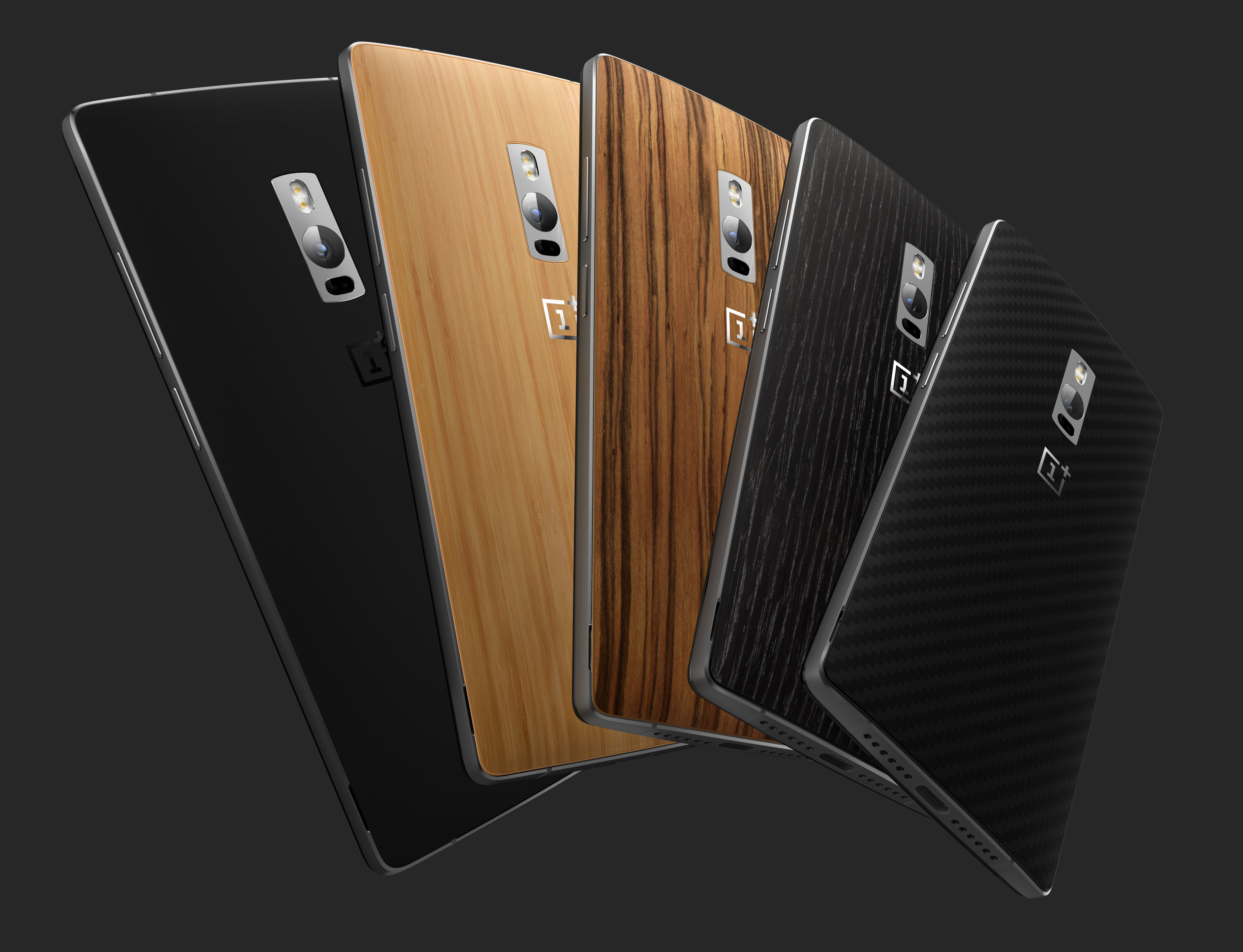
The OnePlus 2’s impressive internals are housed in an aluminium-magnesium alloy frame with stainless steel accents. There are a range of rear covers for the phone too, including bamboo (actual bamboo, not ‘bamboo effect’), ‘Black Apricot (not an actual apricot), rosewood and Kevlar.
OP_s03_c031
The OnePlus 2 is also the company’s first handset to ship with its own Oxygen OS, based on Android 5.1.
The company says the platform is “a refreshing take on the pure Android experience” and allows for “subtle” personalization of the device, like allowing you to switch between using hardware or capacative on-screen buttons.
There are a few custom OxygenOS apps pre-installed in place of regular Android too, like the Camera, Audio Tuner and File Manager.
As was the
irritating case first time around, you’re going to need an invite to buy a OnePlus 2.
In the US and Europe, sales will start (provided you have that invite) on August 11 with the 64GB priced at $389. The slightly lower specced model with 16GB of storage and 3GB of RAM will be available “later” priced at $329, OnePlus says.